




How do beam angle and field angle differ in stage fixtures?
- 1) How do beam angle (50% FWHM) vs field angle (10% point) practically affect lux on-stage at 6–12m throw when choosing LED moving heads?
- 2) Manufacturer specs vary—how can I verify real beam and field angles before buying for theatre or touring rigs?
- 3) When mixing wash and beam fixtures, what beam/field angle combos give even front light across a 12 m stage without hotspots or gaps?
- 4) How do optical accessories (zoom, lenses, linear spreaders, frosts) change beam vs field angle and apparent intensity—and how to spec them to retain gobo sharpness?
- 5) Why do two fixtures with the same published beam angle produce different beam edges and hotspots, and how can I predict beam quality?
- 6) How do I use beam and field angle data together with IES files and DMX/pixel mapping to avoid flicker and maintain color consistency on-camera?
1) How do beam angle (50% FWHM) vs field angle (10% point) practically affect lux on-stage at 6–12m throw when choosing LED moving heads?
Understanding the difference between beam angle and field angle is essential for calculating delivered illuminance. Per IES photometric conventions, beam angle is the cone between the points that fall to 50% of peak intensity (FWHM). Field angle is typically defined at the 10% intensity points. For fixture selection this matters because the narrower the cone (smaller beam angle), the higher the candela and lux on-axis at a given throw distance.
Use the photometric formulas to compare fixtures objectively. Steps:
- Convert total lumens (Φ, lumen output) to luminous intensity (I, candela) using the cone solid angle Ω: I ≈ Φ / Ω where Ω = 2π(1 − cos(θ/2)) and θ is the beam angle in radians.
- Calculate illuminance (E, lux) at distance d: E ≈ I / d² (on-axis).
Example: a 10,000-lumen LED moving head
- Case A: 10° beam angle. Ω ≈ 2π(1 − cos(5°)) ≈ 0.0239 sr → I ≈ 10,000 / 0.0239 ≈ 418,000 cd. At 10 m: E ≈ 418,000 / 100 ≈ 4,180 lux on-axis.
- Case B: 40° beam angle. Ω ≈ 2π(1 − cos(20°)) ≈ 0.3789 sr → I ≈ 10,000 / 0.3789 ≈ 26,400 cd. At 10 m: E ≈ 26,400 / 100 ≈ 264 lux on-axis.
Conclusion: for long throws (6–12 m) a smaller beam angle dramatically increases on-axis lux, which is crucial for front light, specials, or gobo intensity. Use the fixture lumen spec and beam angle to compute candela and expected lux—this is more reliable than trusting a vague ‘‘bright’’ claim.
2) Manufacturer specs vary—how can I verify real beam and field angles before buying for theatre or touring rigs?
Manufacturers sometimes list beam/field angles without full photometric backing. To validate:
- Ask for the IES/LM-63 photometric file and luminous intensity distribution (LDT) data. Proper IES files include candela distributions across angles and let you calculate beam and field angles precisely.
- On-site test method: mount the fixture at intended throw distance, place a calibrated lux meter on-axis and slide it laterally across the beam at a measured perpendicular distance. Record where readings drop to 50% (beam edge) and ~10% (field edge) of peak. This gives practical beam/field values under your rig's environment.
- Beware smartphone lux apps: they are often inaccurate for photometric edge detection. Use a calibrated lux meter and tape measure.
- If buying sight-unseen, request measured beam/field angle reports from the manufacturer and compare to independent third-party photometry, or ask for sample units to test at a local rental house.
These verification steps avoid surprises like underpowered specials or spotty wash coverage on venue night.
3) When mixing wash and beam fixtures, what beam/field angle combos give even front light across a 12 m stage without hotspots or gaps?
This is a common rigging pain point. Use geometry: for a fixture at distance D, the field cone radius r = D × tan(field_angle / 2). Coverage diameter = 2r. To cover a stage width W, you need N ≈ ceil(W / (effective coverage per fixture)). Allow overlap (20–40%) to avoid gaps and smooth edges.
Worked example: stage width W = 12 m, fixture trim height D = 8 m.
- Fixture A: field angle = 40°. r = 8 × tan 20° ≈ 8 × 0.364 ≈ 2.91 m → diameter ≈ 5.82 m. Bare coverage per fixture ≈ 5.82 m, so N ≈ ceil(12 / 5.82) ≈ 3 fixtures. With 30% overlap you should use 4 fixtures or tighten spacing.
- Fixture B (wider wash): field = 60°. r = 8 × tan 30° ≈ 8 × 0.577 ≈ 4.62 m → diameter ≈ 9.24 m; N ≈ ceil(12 / 9.24) ≈ 2 fixtures, but intensity drops; ensure lumen output high enough.
Best practice: pair narrower beam/mid-angle fixtures for specials (10°–25°) and wider wash fixtures (40°–60°) for key/fill. Use overlap of 20–30% between adjacent fixtures to smooth edges. Always compute delivered lux (see Q1) to ensure the wash fixture provides sufficient illuminance at its wider field.
4) How do optical accessories (zoom, lenses, linear spreaders, frosts) change beam vs field angle and apparent intensity—and how to spec them to retain gobo sharpness?
Optics modify both angular spread and central intensity. Key points:
- Zoom optics change beam angle continuously: total lumen output roughly constant, but candela scales inversely with solid angle. Narrower zoom → higher candela; wider zoom → lower candela.
- Diffusers/frosts increase field angle and soften edges but reduce local intensity. Typical light loss depends on material: light frost/softening may reduce output 10–30%; heavier diffusion can reduce 40%+. Always ask manufacturers for lumen loss or measure with a lux meter.
- Linear spreaders and beam shapers move energy horizontally/vertically to avoid spill but shift hotspot geometry—they may not change total lumens but shift intensity distribution.
- Goboes require a focused, high-contrast optic (ellipsoidal/spot with good projection lens). Adding frost or heavy diffusion after a gobo will noticeably soften or wash out the gobo. If sharp gobo projection is required, spec ellipsoidal fixtures with dedicated gobo slots and avoid diffusion in the optical path.
Recommendation: if you need both sharp gobos and soft washes from the same rig, select fixtures with interchangeable front/zoom optics or use separate spot and wash units so one can maintain gobo sharpness while the other provides soft color washes.
5) Why do two fixtures with the same published beam angle produce different beam edges and hotspots, and how can I predict beam quality?
Beam quality depends on more than the numeric beam angle. Factors include:
- LED emitter type: COB (single-chip) emitters produce smoother, single-halo beams. Multi-die arrays or cluster LEDs can show pixelation or multiple hotspots if optics don’t homogenize the mix.
- Optical design: quality of the reflector, lens coatings, aspheric elements, and internal homogenizing chambers determine how uniform the beam is. High-end fixtures often use integrating rods or mixing chambers to remove hot spots.
- Gobo/iris/slot geometry: mechanical tolerances affect edge definition and concentricity.
- Manufacturers' test conditions: beam angle measured from center axis under lab conditions may differ from real deployment where thermal droop or current drive changes LED emission pattern.
To predict beam quality:
- Prefer fixtures with published IES files showing full angular candela plots—look for smooth angular curves without multiple peaks.
- Ask whether the fixture uses a COB or homogenized array; request field photos at intended throw distances.
- Test sample units in a venue mock-up to check edge softness, gobo clarity, and any multi-peaked distributions.
6) How do I use beam and field angle data together with IES files and DMX/pixel mapping to avoid flicker and maintain color consistency on-camera?
When fixtures are used on-camera (streaming, TV broadcast), photometric and temporal parameters both matter:
- Photometrics: use the beam/field angle plus the IES file to compute camera exposure values (lux at subject) and ensure even coverage and correct white balance for your camera settings. IES files allow realistic rendering in visualization software and help plan pixel-mapping where each pixel's projected area must be known.
- Color metrics: specify CRI (Ra) and TLCI for broadcast. For camera work, aim for CRI > 90 and TLCI > 90 to avoid color rendering issues. Also check reported spectral power distribution (SPD) for LED bins; some RGBW fixtures show color metamerism under skin tones.
- Temporal behavior: PWM frequency affects camera flicker. Many cameras (especially with rolling shutters) show flicker if fixture PWM ≲ 3–4 kHz. For broadcast, specify fixtures with PWM ≥ 12 kHz or use DC-driven drivers to eliminate visible flicker. Ask vendors for measured PWM frequency and scope traces.
- Pixel mapping: when pixel-mapping LED zones for effects, match beam/field angle coverage per pixel so mapped content aligns physically on stage. Use the fixture's IES/photometric XY mapping or calibration in your visualization software to avoid misalignment.
Final checklist for camera use: verify lux levels at camera exposure, confirm CRI/TLCI specs, request PWM frequency data, and use IES files for precise pixel mapping. These steps prevent surprises on live broadcasts.
Concluding summary — advantages of LED stage lights and informed fixture selection
Choosing LED stage lights with an informed understanding of beam angle vs field angle, photometrics, optics, and temporal/color performance delivers clearer benefits: higher usable on-stage lux with energy-efficient fixtures, predictable coverage using IES-based calculations, cleaner gobo projection when optics are matched to the task, and camera-safe operation when CRI/TLCI and PWM specs are respected. Proper spec’ing reduces rental and re-rig costs, minimizes show-night troubleshooting, and improves audience and broadcast results.
Authored by the VelloLight technical team—if you'd like a quote tailored to your venue or touring needs, contact us at info@vellolight.com or visit www.vellolight.com for assistance.
Major categories
Do you ship internationally?
Yes. We offer sea, air, and express delivery to many countries and regions worldwide.
What is the usual lead time?
Standard models are typically shipped within 7–15 working days after payment. Customized items may vary.
What is the warranty period for your products?
Most products come with a standard 1–2 year warranty. Please refer to product details or contract terms for specifics.
Do your products support customization?
Yes. We offer OEM and ODM services tailored to project needs, including design, optics, and control compatibility.
Do you offer samples?
Samples are available for certain models. Please confirm with our sales team for details.
You may also like
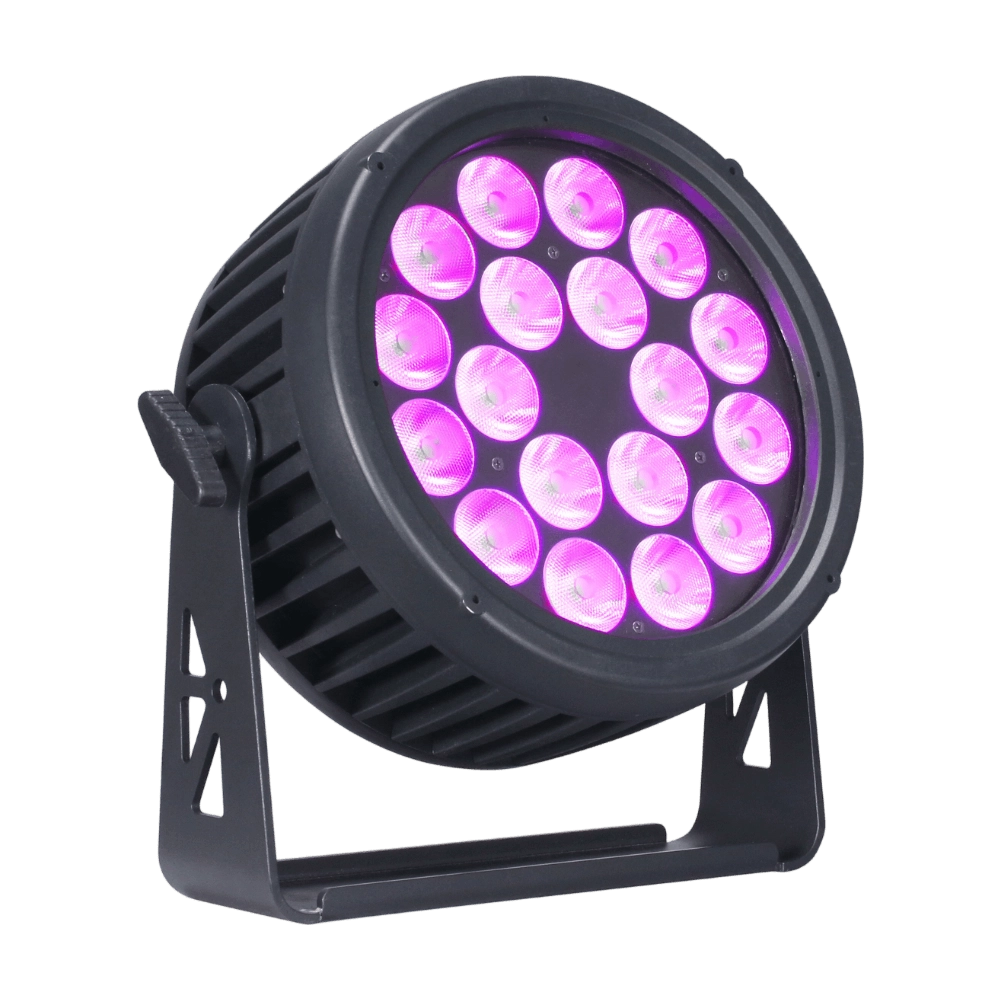
The LED Mac Par 18 offers 180W of output with 18 × 10W RGBW LEDs for brilliant, even color washes. Featuring a long 50,000-hour LED lifetime, flicker-free output, and 25°/45° lens options, it ensures flexibility in stage, event, and installation setups. Its rugged die-cast aluminum housing, IP65 rating, and DMX control modes make it a versatile wash solution.
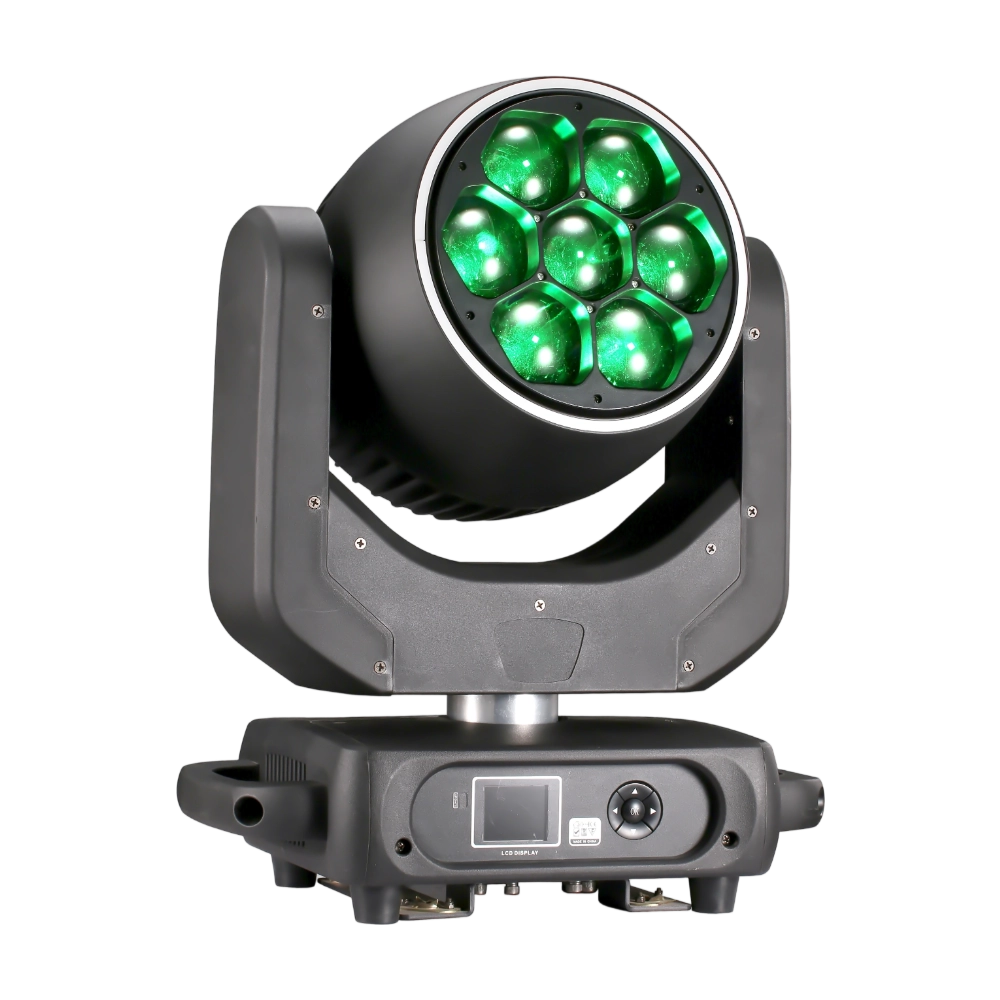
LED Bee Eyes K7 is a 500W moving head wash fixture equipped with 7 × 60W Osram RGBW LEDs plus 48 × 0.5W RGB auxiliary LEDs, delivering intense output and rich color effects. With a 4°–45° electronic zoom, wide CTO range (2700K–8000K), and individual pixel control, it enables stunning visuals from tight beams to smooth washes. Rotation lens effects add dynamic movement, while 540° pan / 270° tilt and multiple DMX channel modes ensure creative flexibility. Compact yet powerful, the K7 is ideal for concerts, clubs, and large-scale shows demanding vibrant color and versatile effects.
Golden Eyes 250IP is a 300W outdoor-rated blinder and effect fixture, featuring a 250W COB LED as the main light source and 16 pieces of 3W RGB LEDs as secondary effects. With IP65 protection, selectable CCT (1800K / 3200K / 5600K), a strong strobe, and a retro-style background glow, it delivers both a powerful punch and creative atmospheres. Silent, flicker-free operation, multiple DMX modes, and robust housing make the Golden Eyes 250IP ideal for concerts, festivals, and outdoor productions.
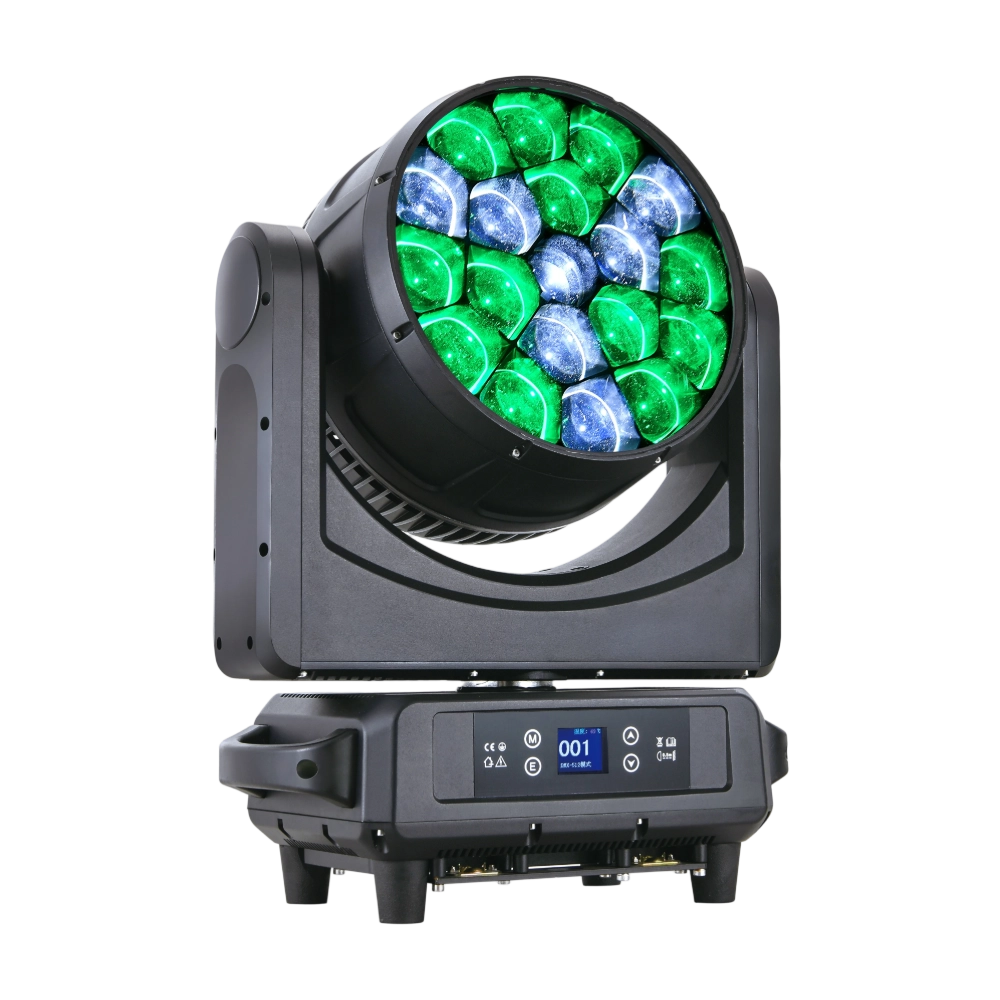
The LED Bee Eyes K19 IP is a 750W IP65-rated moving head wash, powered by 19 × 40W Osram RGBW LEDs for stunning brightness and vibrant colors. With a 4°–45° electronic zoom, wide CTO range (2700K–8000K), and a rotating lens wheel for dynamic visual effects, it delivers both powerful beams and smooth washes. Each LED can be controlled individually, enabling advanced pixel mapping and creative effects. Featuring 540° pan / 270° tilt, multiple DMX channel modes, and robust die-cast aluminum housing with excellent heat dissipation, the K19 IP is built for high-output performance in demanding outdoor and indoor productions.
◌ Let Us Support Your Project
Request a Custom Quote and Technical Support
Fill out the form below, and our sales team will contact you shortly with product details, pricing, and customer service options.
Rest assured that your privacy is important to us, and all information provided will be handled with the utmost confidentiality.
By clicking "Send your message," I agree to your processing my personal data.
To see how to withdraw your consent, how to control your personal data, and how we process it, please see our Privacy Policy and Terms of Use.
Over 20 Years of Innovation in Stage & Studio Lighting
© 2026 VELLO. All Rights Reserved. 粤ICP备20023734号
Join our socials
VELLO
Whatsapp: +8613902276704
Vello Lighting
VelloLights