





How to Choose LED Fixtures for Concerts and Theatres
- Essential Principles for Effective Stage Lighting
- Understand the show and venue before buying stage lighting
- Key LED Fixture Types for Stage Lighting
- Technical Specifications That Matter for Stage Lighting
- Lumen output vs. lux on stage
- Color rendering, white balance and RGB options
- Beam control: zoom, lenses, gobos and shutters
- Flicker and camera compatibility
- Control protocols and networking
- Practical Selection Process & Budgeting for Stage Lighting
- Step 1: Site survey and rigging plan
- Step 2: Determine core kit vs. touring extras
- Step 3: Budgeting and lifecycle costs
- Energy, Heat and Maintenance Considerations for LED Stage Lighting
- Compatibility, Control and Integration for Stage Lighting
- DMX, Art-Net and sACN
- Video and camera integration
- Comparing Fixtures: A Short Technical Table
- Why Choose a Trusted Manufacturer for Stage Lighting
- VELLO Light: Manufacturing Strengths and Product Offerings for Stage Lighting
- Checklist: Final Questions to Ask Before Buying LED Stage Lighting
- Frequently Asked Questions (FAQ)
- 1. What wattage or lumen rating should I look for in stage lighting fixtures?
- 2. Do I need high CRI for concerts?
- 3. Are all LED fixtures camera-friendly?
- 4. Is it better to rent or buy LED stage lighting?
- 5. How do I avoid DMX addressing and network issues?
- 6. What maintenance do LED fixtures require?
- Contact & Next Steps
- References
Essential Principles for Effective Stage Lighting
Understand the show and venue before buying stage lighting
Choosing LED fixtures for concerts and theatres starts with a clear brief: what is the show style (concert, musical, drama, dance), venue size (club, regional theatre, arena), rigging constraints, touring vs. fixed installation, and integration with video/camera systems. These variables define fixture classes, brightness levels, beam control, and control protocols you will need in your stage lighting system.
Key LED Fixture Types for Stage Lighting
Different fixture types perform different roles in modern stage lighting. Below is a practical comparison to match fixtures to tasks.
| Fixture Type | Typical Use | Beam Angle | Control | Power (typ.) | Price Range (USD) |
|---|---|---|---|---|---|
| Moving Head (Beam/Wash/Spot) | Main concert looks, specials, effects | 2°–60° (model dependent) | DMX/Art-Net/sACN, pan/tilt | 150–2000W (LED equivalents 100W–1000W) | $700–$8,000 |
| LED Wash (Par-style wash) | Even stage washes, color blending | 10°–60° | DMX, sometimes onboard programs | 20–400W | $100–$1,200 |
| LED PAR | Stage footlights, uplights | 15°–60° | DMX | 10–200W | $50–$600 |
| Profile / Ellipsoidal (LED spot) | Sharp beam, gobo projection, specials | 8°–40° (fixed or zoom) | DMX or 0–10V | 100–1000W (LED equiv. 100–600W) | $600–$3,500 |
| LED Bar / Linear | Stage washes, cyc lighting, effects | Wide, linear | DMX, pixel-mapped | 30–400W | $150–$1,500 |
| Studio / Fresnel (LED) | Soft key/fill, TV-friendly lighting | 20°–60° | DMX or local control | 50–600W | $200–$1,200 |
Note: Price ranges vary by brand, features (zoom, CRI, PWM frequency) and market. Use the table to map required functions to fixture types before selecting models.
Technical Specifications That Matter for Stage Lighting
Lumen output vs. lux on stage
Manufacturers specify lumens; designers work in lux at performer positions. For concert stages, aim for 500–2,000 lux at performer plane for mid-sized venues depending on production needs. For theatre plays, 300–1,200 lux is typical. Always run photometric calculations (IES files) or test rigging to verify the delivered lux with your chosen fixtures and hang positions.
Color rendering, white balance and RGB options
Pay attention to CRI (Color Rendering Index) and TM-30 values where available. For theatrical/televised work, CRI >90 and high TM-30 fidelity produce natural-looking skin tones. RGB mixes are standard for saturated colors; RGBW/RGBA/RGBWW and variable color-temperature emitters give better pastel whites and warm-to-cool white tuning for theatrical color palettes.
Beam control: zoom, lenses, gobos and shutters
For concerts you often need narrow beams and high-intensity shafts; moving head beam fixtures with tight beam angles and gobos are ideal. For texturing and stage washes, zoom-capable wash fixtures or LED bars are more flexible. Ellipsoidals (profiles) remain the choice for crisp shutter cuts and gobo projections in drama and musicals.
Flicker and camera compatibility
If your production is recorded or live-streamed, ensure LED fixtures use high PWM frequency or flicker-free driver designs. Camera sensors can reveal flicker even if the human eye cannot. Look for fixtures specifying flicker-free operation at common frame rates (e.g., 24/25/30/50/60 fps) or explicit PWM frequency (often >2 kHz recommended for broadcast).
Control protocols and networking
DMX512 remains the baseline control protocol for stage lighting. For large rigs, look for Art-Net or sACN support and RDM for remote addressing and monitoring. For pixel-mapped LED bars or effects, confirm pixel count and addressing scheme. Always ensure compatibility with your lighting console and network topology.
Practical Selection Process & Budgeting for Stage Lighting
Step 1: Site survey and rigging plan
Perform a detailed site survey to document truss positions, grid heights, power distribution, circuit capacity, and sightlines. Identify weight limits and cable routes. A mismatch between fixture weight and rigging capacity is a common failure point: plan headroom for safety.
Step 2: Determine core kit vs. touring extras
Decide what equipment is permanent vs. what must be ruggedized for touring. Touring fixtures require robust housings, quick-lock power/data connectors, and accessible service panels. Permanent theatre installs can prioritize fixture aesthetics and quiet operation.
Step 3: Budgeting and lifecycle costs
Factor total cost of ownership: initial purchase, spare parts (drivers, lenses), labor for maintenance, DMX nodes, and eventual replacement. LED fixtures reduce lamp-replacement costs but still require fan/driver service and periodic recalibration.
Energy, Heat and Maintenance Considerations for LED Stage Lighting
LED fixtures typically reduce power consumption versus traditional discharge lamps. According to the U.S. Department of Energy, LEDs can reduce lighting energy use by 30–80% depending on the application (see references). Less heat output reduces HVAC loads backstage, but high-power LEDs still need adequate cooling. Check manufacturer thermal specs and ensure fixtures are ventilated and not exposed to dust or moisture.
Compatibility, Control and Integration for Stage Lighting
DMX, Art-Net and sACN
Confirm the fixtures support the control protocol you use. DMX512 is universal; Art-Net and sACN are recommended for large networks. RDM enables remote addressing and simplifies maintenance during load-ins.
Video and camera integration
For multi-camera broadcasts, confirm CRI, flicker-free specifications, and tunable white ranges to match camera color temperatures. Coordinate cues between lighting and video playback systems to avoid visual conflicts (e.g., camera exposure vs. bright beams).
Comparing Fixtures: A Short Technical Table
| Spec | Moving Head Beam | LED Wash | Profile / Ellipsoidal |
|---|---|---|---|
| Typical Lux at 10m | 200–4,000 lux (model dependent) | 100–1,200 lux | 300–2,500 lux |
| CRI | 80–95+ | 80–95+ | 90+ |
| Flicker Control | High-PWM or DC drivers (check spec) | Varies — check for camera use | Generally robust for theatre |
Use photometric files (IES/IESNA .ies files) supplied by manufacturers to model real-world output in CAD or lighting design software (e.g., WYSIWYG, Vectorworks Spotlight).
Why Choose a Trusted Manufacturer for Stage Lighting
Reliability matters: a single fixture failure on opening night can be costly. Choose vendors with solid warranties, documented service networks, and spare-part availability. Evaluate fixture MTBF, driver warranty, and customer references. For touring work, insist on roadworthy construction and easy-to-replace components.
VELLO Light: Manufacturing Strengths and Product Offerings for Stage Lighting
Vello Light Co., Ltd., established in 2003, is a comprehensive technology enterprise integrating R&D, manufacturing, and sales. Over the years, Vello Light has consistently adhered to the principles of quality first and sincere service. With the support and help of numerous customers both domestically and internationally, the company has continued to grow and develop, gradually becoming a unique and outstanding team in the stage lighting field.
In recent years, with the rapid development of the LED lighting market, Vello Light has gathered a large number of professional talents to provide comprehensive and systematic services, including product R&D, manufacturing, marketing, engineering installation, and product maintenance. Through the joint efforts of Vello people, Vello remains true to its original aspirations and perseveres in innovation, leveraging unique advantages to stand out in fierce competition. Currently, Vello products are exported both domestically and internationally and have a strong brand reputation, especially in overseas markets.
VELLO is a registered brand specializing in moving head stage lights, studio lights, LED effect lights, LED bar lights, LED par lights, and outdoor stage lighting. Customers praise VELLO for professional technology, unique styles, high-quality materials, and durability. Vello positions itself to become a world-leading stage lighting manufacturer by emphasizing:
- Comprehensive R&D and rapid product iteration aligned with industry trends
- Manufacturing controls and testing procedures to ensure long-term reliability
- Export experience and international compliance for touring and installation markets
- Product range that covers moving heads, studio fixtures, and outdoor-rated stage lighting
If you seek fixtures combining competitive pricing, broad feature sets (high CRI, flicker-free drivers, Art-Net/sACN support), and export-proven quality, VELLO Light is a manufacturer to consider during vendor selection.
Checklist: Final Questions to Ask Before Buying LED Stage Lighting
- Can the fixture meet required lux levels at planned hang distances? (Request IES file.)
- Is the CRI/TM-30 sufficient for live and camera work?
- Does the fixture specify flicker-free operation at my target frame rates?
- Which control protocols does it support (DMX, Art-Net, sACN, RDM)?
- What is the warranty, availability of spare parts, and expected service turnaround?
- Does the manufacturer provide photometric and mechanical data for planning and rigging?
Frequently Asked Questions (FAQ)
1. What wattage or lumen rating should I look for in stage lighting fixtures?
Wattage is only a rough indication. Use lumens and, more importantly, lux at performer height. For mid-size concerts aim for 500–2,000 lux on stage areas; for theatre plays 300–1,200 lux depending on the scene. Request IES photometrics to model actual lighting.
2. Do I need high CRI for concerts?
High CRI (>90) improves natural skin tones and color fidelity, especially important for theatre and broadcast. Concerts with very saturated colors can accept lower CRI for some effects, but key front lights and specials should have high fidelity.
3. Are all LED fixtures camera-friendly?
No. Some low-cost LEDs use low PWM frequencies causing visible flicker on camera. For broadcast or live streaming, choose fixtures that specify flicker-free operation and mention camera frame rates in their specs.
4. Is it better to rent or buy LED stage lighting?
Buy when you need long-term ownership, consistent aesthetics, and installation permanence. Rent for one-off tours or if cashflow prohibits large CAPEX. Consider total cost of ownership — maintenance, spares, and depreciation — when deciding.
5. How do I avoid DMX addressing and network issues?
Use RDM-capable fixtures for remote addressing. Label cables and maintain a network diagram. Use Art-Net/sACN nodes for large arrays and segregate power and data cabling to reduce interference.
6. What maintenance do LED fixtures require?
Regular cleaning of optics and cooling vents, firmware updates, inspection of power/data connectors, and replacement of fans or drivers as they age. Keep spare units or critical spare parts for touring rigs.
Contact & Next Steps
Ready to specify fixtures or request photometrics? Contact Vello Light Co., Ltd. for product brochures, IES files, and quotations tailored to your concert or theatre project. For technical consultations on rigging, control setup, and fixture selection, reach out to Vello Light sales or your local distributor to arrange a site survey and demo.
References
- DMX512 protocol — Wikipedia, https://en.wikipedia.org/wiki/DMX512 (accessed 2025-12-13)
- LED lighting benefits — U.S. Department of Energy, LED Lighting, https://www.energy.gov/energysaver/save-electricity-and-fuel/lighting-choices-save-you-money/led-lighting (accessed 2025-12-13)
- Lighting terminology and photometry — Illuminating Engineering Society (IES), https://www.ies.org/ (accessed 2025-12-13)
- LED flicker and camera issues — Flicker (light), Wikipedia, https://en.wikipedia.org/wiki/Flicker_(lighting) (accessed 2025-12-13)
- Photometric files and IES data — IESNA: IES file format, Lighting Handbook sources, https://www.ies.org/ (accessed 2025-12-13)
- Market and product comparisons — general manufacturer datasheets and product IES files (consult individual vendor pages for model-specific data) (accessed 2025-12-13)
How to Integrate Stage Lighting with Sound and Video
DMX Control for LED Stage Lights: A Beginner's Guide
Stage LED Lights Maintenance, Cleaning and Lifespan Tips
High-Power LED Stage Lights for Large Arenas
Major categories
What is the warranty period for your products?
Most products come with a standard 1–2 year warranty. Please refer to product details or contract terms for specifics.
Do you offer samples?
Samples are available for certain models. Please confirm with our sales team for details.
Do your products support customization?
Yes. We offer OEM and ODM services tailored to project needs, including design, optics, and control compatibility.
Do you ship internationally?
Yes. We offer sea, air, and express delivery to many countries and regions worldwide.
What is the usual lead time?
Standard models are typically shipped within 7–15 working days after payment. Customized items may vary.
Stage LED Par Light LED ZOOMPAR 40
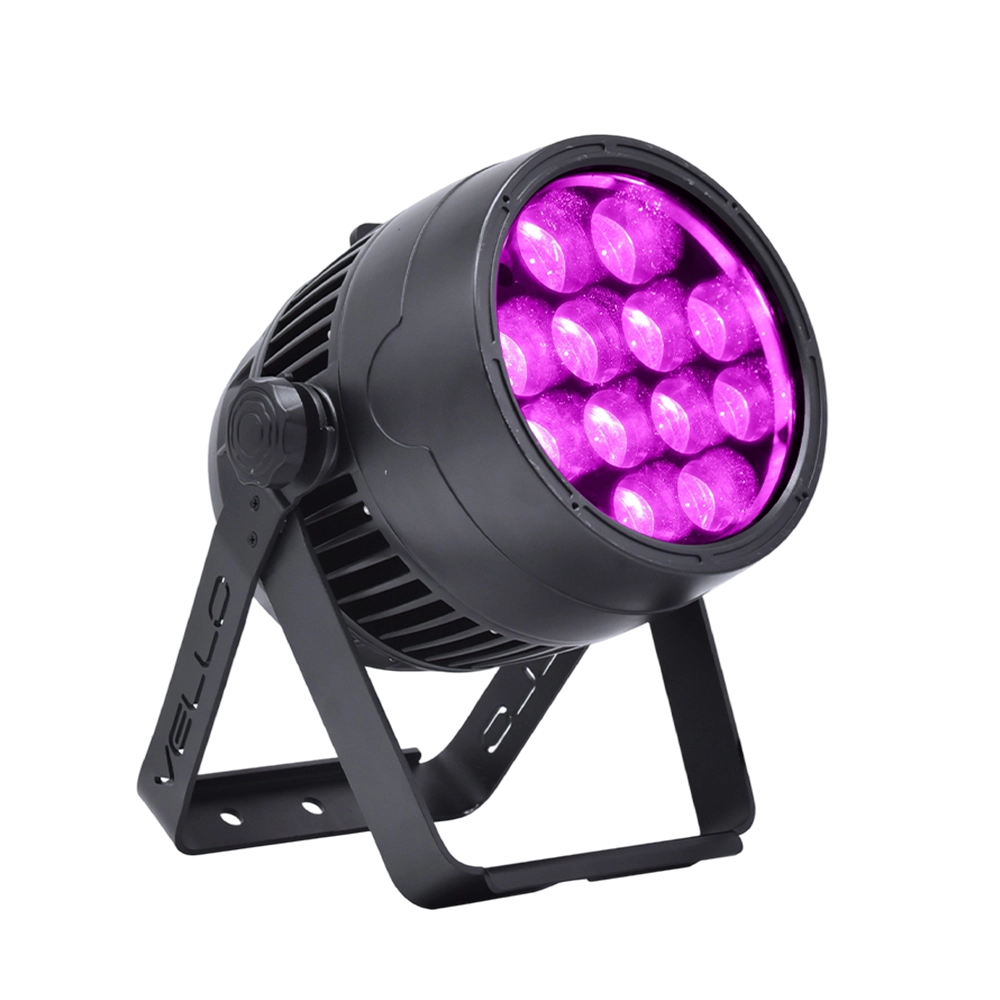
The Vello Zoom Par 40 IP is a powerful outdoor LED wash light equipped with 12x high-power 7-in-1 RGBACL LEDs. Designed for durability and rich color rendering, it features a wide motorized zoom (6°–50°), smooth dimming, and adjustable CTO presets (3200K–7500K), with 90+ CRI. With an IP66-rated die-cast aluminum body, it’s ideal for both indoor and outdoor applications, including stage lighting, architecture, live events, and installations.
Moving Head Stage Light BEAM 400
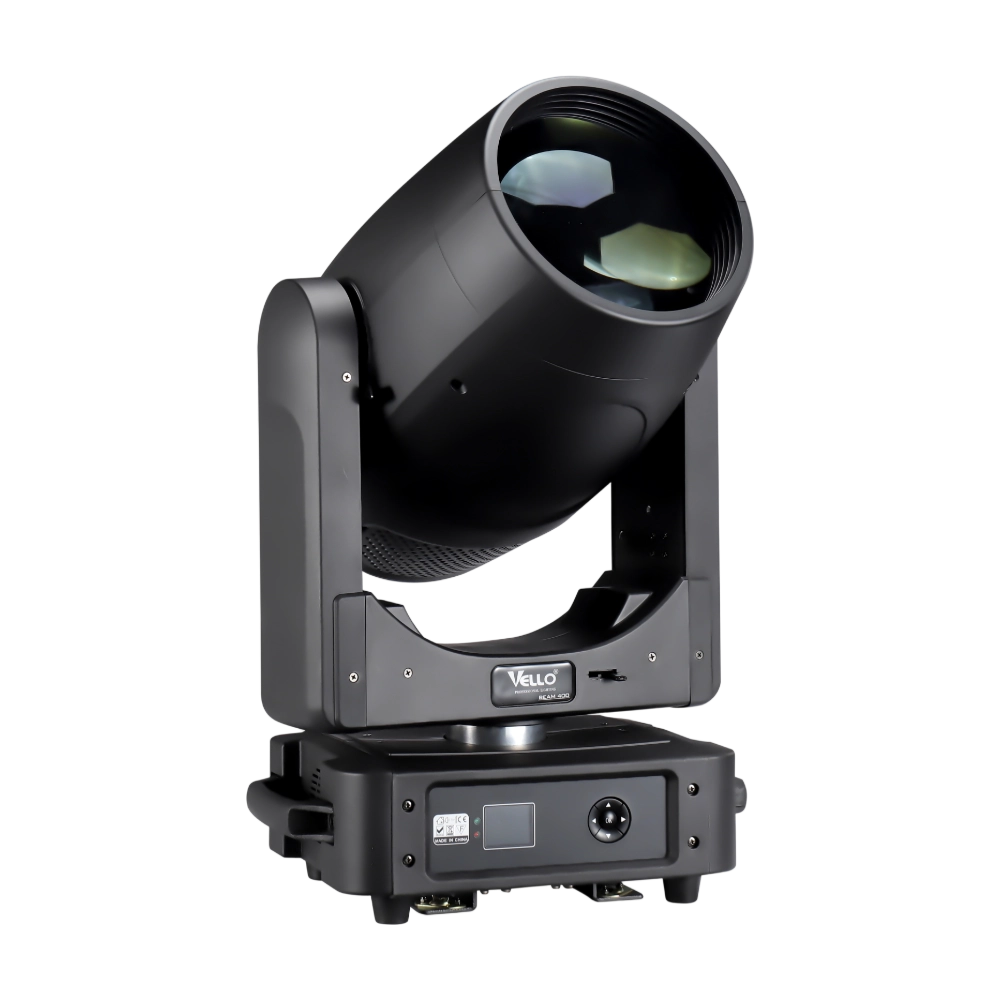
BEAM400 is a 500W professional moving head beam powered by an OSRAM SIRIUS 371W discharge bulb, delivering a super-bright 1.8° sharp beam with impressive punch. It features 12 fixed gobos + open, a 14-color wheel, and a 16-facet circular rotating prism with multiple-facet effects, enabling dynamic aerial visuals. With 540° pan / 270° tilt, 16-bit movement resolution, and linear frost and focus, BEAM400 ensures precise and versatile performance. Comparable to traditional 750W moving heads, it combines high efficiency, smooth dimming, and reliable operation—ideal for concerts, tours, and large-scale stage productions.
Moving Head Stage Light BEAM 360
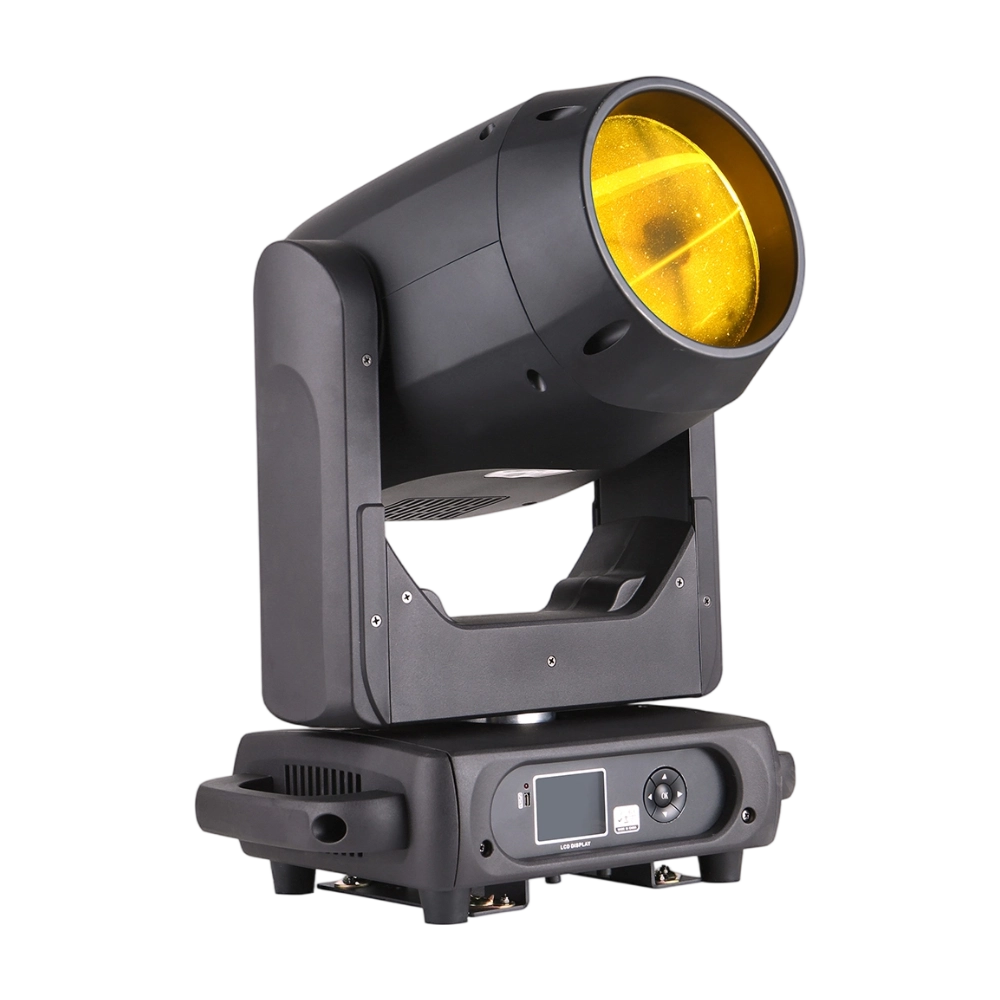
BEAM360 is a 400W high-power moving head beam equipped with an OSRAM SIRIUS 311W discharge lamp, delivering a sharp 1.8° beam with super brightness. It features 14 colors + open, 12 fixed metal gobos + open, and dual prisms (8-facet circular + 8+16 multi-facet combination) for dynamic aerial effects. With 540° pan / 270° tilt, 16-bit movement, and linear frost and focus, BEAM360 ensures precision and versatility. Compact yet powerful, it rivals traditional 575W moving heads, making it ideal for concerts, clubs, and large-scale stage productions.
Moving Head Light BEAM 450
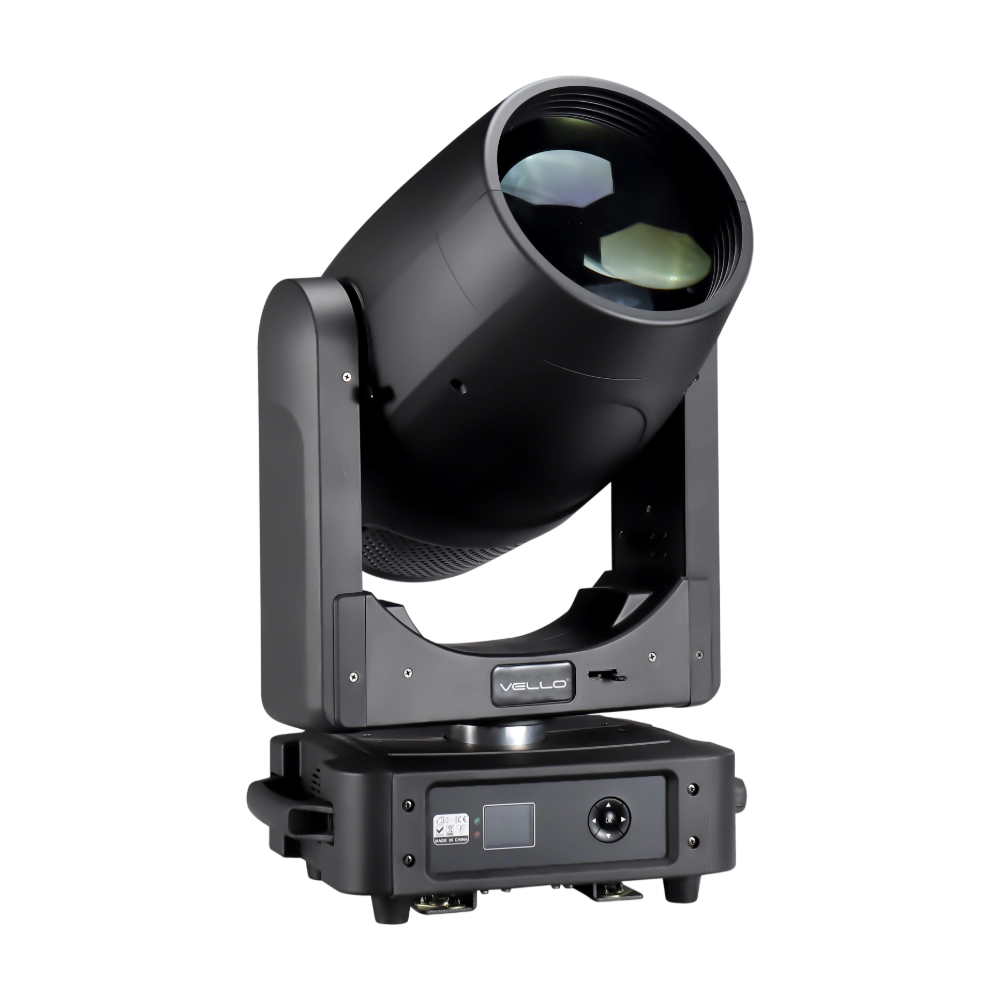
The BSW450 is a high-performance moving head fixture equipped with an original Osram 420W bulb, delivering exceptional brightness, precision, and versatility. Designed for professional stage applications, it seamlessly combines beam, spot, and wash functions in one compact unit, making it a powerful all-in-one lighting solution.
Over 20 Years of Innovation in Stage & Studio Lighting
© 2026 VELLO. All Rights Reserved. 粤ICP备20023734号
Join our socials
VELLO
Whatsapp: +8613902276704
Vello Lighting
VelloLights